Sensitive content
This site contains sensitive content that includes references to sexual violence.
This fact sheet is one of the Out of the Shadows Index advocacy tools. It explains what the Justice pillar tracks—including both offline and online dimensions—what the scores mean, and how to use the findings in your advocacy.
It is designed for civil society organizations (CSOs), survivor advocates, youth advocates, and anyone engaging with policymakers and the government on laws, enforcement, and child-friendly justice procedures related to sexual violence against children and adolescents.
Learn about what this pillar measures and how to interpret the scores
This vignette spans the entire Justice pillar and allows you to humanize what good prevention means for the lives of children and adolescents. Use it when you want to tell the full story of what happens when the systems fail and what it looks like when they work, in a way that does not require any survivor’s personal disclosure.
A 15-year-old discloses to a teacher that they have been sexually abused by a family member for years. The teacher doesn't know who to call. Eventually, a report reaches the police but there is no specialized unit. The officer who takes the statement has no training in interviewing children. The child or adolescent is asked to describe what happened in an open office, in adult language, with no support person present.
The family is told that the law does not explicitly criminalize sexual violence by a family member. The case stalls. Months pass. The child or adolescent is called back to give the same account again — and again. When a court date is finally set, the child must face the accused in the same room. There is no option to testify by video or behind a screen.
Then the family learns there is a deadline. The statute of limitations is running out. The system did not fail because the child waited too long to speak but because it was not built to listen.
A 15-year-old discloses to a teacher that they have been sexually abused by a family member for years. The teacher follows a clear reporting pathway. A specialized unit trained in sexual violence against children and adolescents takes the case. An officer interviews the child in a private setting, using age-appropriate language. The interview is video-recorded so the child gives their account once — not five times.
The law is clear: sexual violence by a family member is explicitly criminalized, including by guardians, stepparents, and extended family. There is no statute of limitations — the law recognizes that children often disclose years after their experience. If the perpetrator has crossed a border, extraterritorial provisions and extradition cooperation mean geography is not an escape route.
In court, the child testifies by video link and is shielded from the accused. The system does not ask the child to carry the case, rather it carries the child.
A 12-year-old is contacted by an adult through a gaming platform. It starts with compliments and small gifts and then escalates to requests for images, threats, and coercion. By the time a parent finds out, the images have already been shared.
The parent tries to report. The police say it is "a platform issue." The law does not criminalize grooming unless a physical meeting was planned, so the months of manipulation are treated as legally irrelevant. There is no requirement for the platform or internet provider to report suspected child sexual abuse material. The images stay online. The digital evidence degrades.
The adult is based in another country. There is no mechanism to investigate across borders. The child or adolescent is left feeling that what happened to them online was somehow less real and the system confirms it.
A 12-year-old is contacted by an adult through a gaming platform who grooms and coerces them into sharing sexual images. The law names grooming as a crime — regardless of whether the adult ever intended to meet the child. The coercion and the images are evidence.
The platform and internet service provider are legally required to report suspected child sexual abuse material to a mandated authority. Reporting triggers rapid preservation of digital evidence and action to protect the child. Specialized investigators secure the data before it disappears.
The adult is in another country — but cross-border cooperation is activated. The child receives a trauma-informed response and is never blamed. Online harm is treated as real harm, and the justice system responds quickly, the perpetrator is held accountable, and no other child is harmed.
In a meeting with government
Share the country’s Justice score and use it to anchor a specific, time-bound ask (for example: “Your country scored [X] on intrafamilial sexual violence laws. We are asking you to explicitly criminalize sexual violence against children and adolescents by family members, including guardians and extended family, by [year].”).
In a campaign or public statement
Lead with a human-centered framing that links legal gaps to a child’s lived experience, then name the reform you want (for example: “Close the legal gap. Fund the unit. Protect children in court.”).
At a budget advocacy moment
Pair the legal ask with the capacity ask: specialized investigators, forensic capability, trained prosecutors, and child-friendly court infrastructure.
This fact sheet gives you the evidence. The other toolkit components help you turn evidence into action:
| Component | What it does |
|---|---|
| Meeting toolkit | 10-minute meeting script, 2-minute intervention, accountability questions |
| Email templates | Ready-to-adapt outreach and follow-up emails |
| Finance advocacy: Prevention | Investment arguments, budget line mapping, submission template |




 Albania
 Algeria
 Angola
 Argentina
 Australia
 Bangladesh
 Brazil
 Burkina Faso
 Cambodia
 Cameroon
 Canada
 China
China
 Colombia
 Cote d'Ivoire
 Dem. Rep. of Congo
 Egypt
Egypt
 El Salvador
 Ethiopia
 France
 Germany
 Ghana
Ghana
 Guatemala
 India
India
 Indonesia
 Italy
Italy
 Jamaica
 Japan
Japan
 Kazakhstan
 Kenya
Kenya
 Madagascar
 Malaysia
 Mexico
 Mongolia
 Morocco
 Mozambique
 Nepal
Nepal
 Niger
Niger
 Nigeria
 Pakistan
 Peru
Peru
 Philippines
 Romania
 Russia
 Rwanda
 Saudi Arabia
 Serbia
 South Africa
 South Korea
 Sri Lanka
 Sweden
 Tanzania
 Thailand
 Türkiye
 UAE
UAE
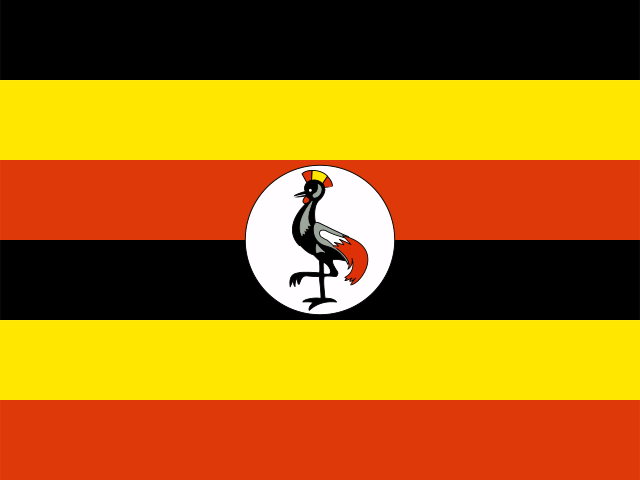 Uganda
 United Kingdom
 United States
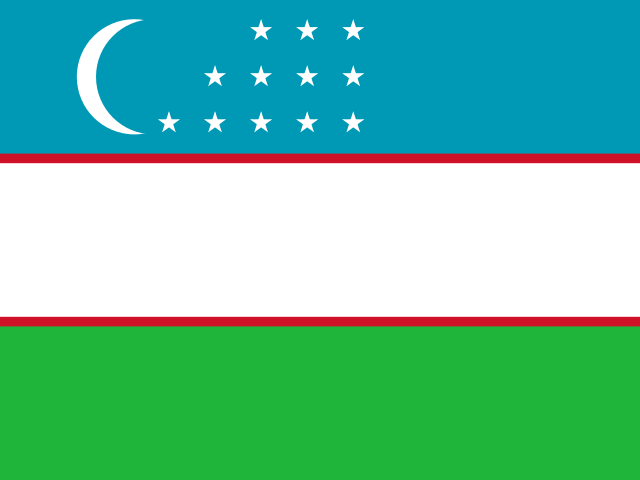 Uzbekistan
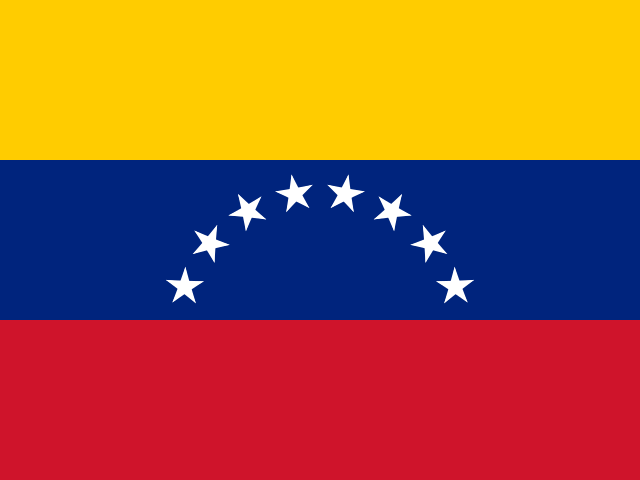 Venezuela
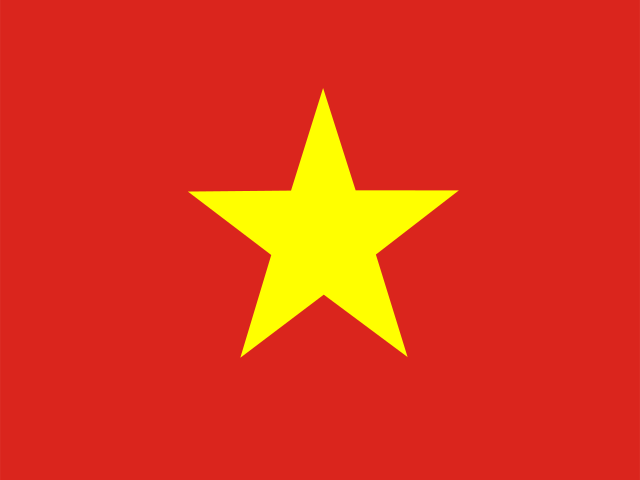 Vietnam